


Vecstrata · June 2026
Our Bet
Satellite direct-to-device means an ordinary phone, unmodified, reaching a satellite where the towers run out. Four kinds of player matter here. The integrated owner-operators own both spectrum and constellation (SpaceX, and now Amazon through Globalstar). The neutral host plugs into everyone's network (AST SpaceMobile). The three nationwide carriers sell the service. And the chipmakers put a modem in every handset (Qualcomm, MediaTek).
Our bet is about who keeps the money once coverage, the layer everyone is watching, turns into a shared commodity. From the February 2024 petition that pried warehoused 2 GHz satellite spectrum loose to a settled D2D stack around 2028, the carrier-coverage rent migrates twice: off the radio interface the carriers are commoditizing, and onto the two scarce complements the open standard cannot reproduce. One is owned mobile-satellite-service (MSS) spectrum. The other is the standards-essential, per-device modem toll. The carriers' mid-2026 spectrum-pooling joint venture is the defensive release valve, not the captor of that rent.
This is a US thesis: US carriers, US-licensed satellite spectrum, the US regulator. Non-US firms enter only as minority stakeholders, never as the players who capture the margin. The cutoff is around end-2028, where the structure settles. The nearest of the calls below is the first resolution point on that arc, not the whole story, and confidence sits highest on the leg the market has priced least: the modem toll.
How We Got Here
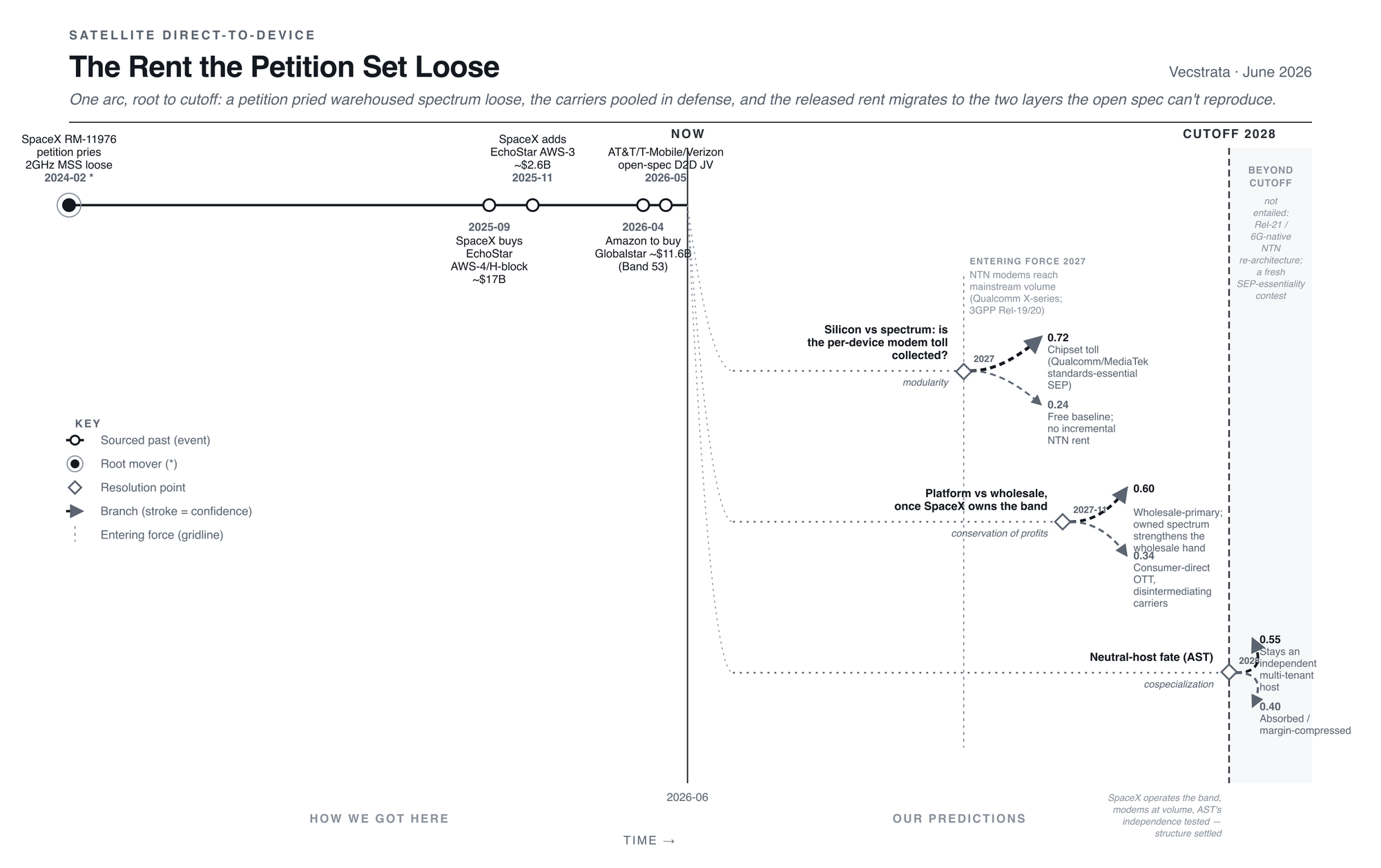
One arc from the February 2024 spectrum-ownership petition to the ~2028 settlement: the sourced past on the left, the three resolution points branching on the right.
The news in mid-2026 is the carrier joint venture. The cause sits two years upstream, in one firm's decision to own spectrum rather than lease it.
A few events made the market physically exist without touching its margins. Hold them apart from the root.
- 2022
3GPP freezes Release 17, the non-terrestrial-network standard, and LEO launch costs keep falling. Without these, D2D doesn't physically exist. - 2024-01-18
AST SpaceMobile takes a strategic investment from AT&T, Google and Vodafone, deepening the carrier-lease model where a satellite gap-filler rents a carrier's spectrum and the carrier keeps the subscriber (AST 8-K). This makes carrier-centric D2D real and preserves the carrier-keeps-the-margin status quo. - 2024-03-15
The FCC adopts the Supplemental Coverage from Space order (FCC 24-28), writing the carrier-lease regime into law, three weeks after a then-pending SpaceX petition to escape it (see the root below) (FCC). It strengthens the status quo this thesis overturns.
Then the root, and the spine that follows it.
- 2024-02-22
ROOT. SpaceX files a Petition for Rulemaking on the 2 GHz MSS band, later docketed RM-11976, to pry the warehoused satellite spectrum loose so it can own spectrum rather than lease a carrier's (SpaceX petition, filed Feb. 22 2024; the FCC sought comment a month later in DA 24-299, 2024-03-26). This is the earliest public move the whole margin shift depends on. - 2025-09-08
SpaceX agrees to buy EchoStar's AWS-4 and H-block spectrum for about $17B (EchoStar). Owned, flexible-use spectrum makes SpaceX an operator independent of the carrier-lease framework. - 2025-11-06
SpaceX adds a follow-on AWS-3 purchase from EchoStar for about $2.6B in stock, finishing the owned-spectrum stack (EchoStar 8-K). - 2026-04-14
Amazon agrees to buy Globalstar for about $11.6B, putting a second integrated owner-operator pole on the board with D2D from around 2028 (CNBC). - 2026-05-14
TRIGGER. AT&T, T-Mobile and Verizon reach an agreement-in-principle on an open-spec, operator-agnostic D2D joint venture (AT&T). It commoditizes the carrier coverage layer. It is the release, not the captor.
Recurring Pattern
When a layer commoditizes, the profit relocates to the adjacent layer that stays scarce. This is Margin Migration, one of the shapes catalogued on our Patterns page.
When one layer of a market becomes a commodity, the profit that lived there doesn't disappear. It moves to the next stage that stays scarce, integrated, or proprietary. The carriers are about to commoditize coverage by pooling it into an open joint venture. The rent that drains out of coverage will reappear at the two stages the open spec leaves untouched: owned spectrum above, and the per-device modem patent below.
The keystone beneath it is the law of conservation of attractive profits: margin is conserved, not destroyed. The pattern has to hold for the calls below to pay. If the released rent simply evaporated into cheaper phone bills, there would be no spectrum re-rating and no modem toll to predict. Naming it commits us to where the money goes, not just that it leaves.
How It Works
The released coverage rent has nowhere to vanish to. It settles on whatever the open standard leaves scarce, and that is the rent migrating twice.
Start with the structure the open standard builds, then follow the money the carriers are letting go of. The order matters. The carrier joint venture is a reaction to the owned-spectrum threat that started in February 2024, not the origin of the change. Read it as the prime mover and every call below inverts.
Modularity: the open spec turns coverage into a commodity, so the carriers stop owning it
An open, operator-agnostic standard does one thing cleanly. It makes the layer it standardizes substitutable. Once any carrier's traffic can ride any compliant constellation under one shared spec, no single carrier's coverage is scarce anymore.
That is exactly why the three nationwide carriers chose to pool their satellite spectrum into a joint venture instead of each defending a private deal. They are not seizing a new market. They are conceding that coverage is turning into a commodity and salvaging shared bargaining power on the way down. Standardize an interface and you commoditize the layer behind it.
Margin migration: the released rent lands on owned spectrum and the device modem
Commoditizing coverage doesn't destroy the profit that sat in it. By conservation of attractive profits, the rent relocates to the adjacent stages the open spec leaves scarce. There are two of them, and that is the whole bet.
Upstream sits owned MSS spectrum. SpaceX spent about $17B to own AWS-4 rather than lease a carrier's, which is precisely the move the open spec cannot copy, because the spec standardizes the radio interface, not the license. Downstream sits the device modem. Every unmodified phone needs silicon that speaks the NTN standard, and that silicon is the same no matter which constellation supplies the bits.
The released rent pools above the carriers and below them, never in the layer they just gave up.
Bottleneck: licensed spectrum and the standards-essential modem are the hard inputs, and the toll-collectors sit on both
Sort the binding constraints from the soft ones. Coverage was soft, a matter of contracts and convention, which is why an open spec could dissolve it overnight. Two things underneath it are hard, and the rent can only land on those.
Licensed MSS spectrum is finite, granted by the regulator, and gets more valuable the more traffic rides it. You cannot route around it. The standards-essential modem is the other hard input: every prior radio generation became a per-handset patent toll under the good-enough timing rule, and there is no reason this one breaks the streak. Profit settles on the licensed and the standards-essential, the two stages you cannot substitute your way past.
That also splits the integrated owner from the neutral host. SpaceX's spectrum, constellation and launch are locked inside one firm, so the owned-spectrum rent accrues to it directly. AST SpaceMobile is a neutral host: its value is tied to serving all carriers through the open spec. The many-partner lock protects its independence, since no single carrier can capture it without devaluing it for everyone else. But the same position exposes its margin, because the rent is migrating past it on both sides, the spectrum owner above and the modem toll below. A many-partner lock buys independence, not margin safety, when the money is leaving on both flanks.
Our Predictions
These are the resolution points of one forward arc, ordered from the nearest event to the 2028 cutoff. Each is a structural question with rival branches, and each branch probability is anchored to precedent and held humble. Horizons are estimated entering-force dates.
1 · Platform vs wholesale
Once SpaceX owns AWS-4/H-block and is free of the carrier-lease framework, it keeps selling D2D wholesale through the carriers and the open spec rather than flipping to a consumer-direct service that cuts them out.
Confidence 60% · Horizon ~2027-11
Wrong if: by ~2027-11 SpaceX launches a consumer-direct D2D retail offer that bypasses the carriers (consumer-direct over-the-top (OTT) branch, 0.34; close slips past horizon, ~0.06). Precedent: Clearwire's 2.5 GHz spectrum was absorbed by Sprint as capacity, not turned into retail disintermediation (~2/3 base rate). The AWS-4/H-block close is the gating event, expected around 2027-11; FCC approval was secured in May 2026 under a roughly $2.4B escrow condition.
2 · Silicon vs spectrum: the per-device modem toll
As 3GPP-standardized NTN diffuses into mainstream handsets over 2027–2028, the per-device margin settles into a standards-essential modem royalty that Qualcomm and MediaTek collect, orthogonal to which constellation wins, rather than shipping as a free, un-tolled baseline.
Confidence 72% · Horizon ~2027–2028
Wrong if: by ~2028 mainstream NTN handset support ships as a free, un-tolled baseline feature with no per-device standards-essential-patent (SEP) royalty attaching (free-baseline branch, 0.24; no volume devices ship, ~0.04). Precedent: every prior 3GPP radio generation became a per-handset SEP royalty (roughly 3.25–5% capped on the first $400; ~100% base rate). Held below 0.75 because NTN-specific essentiality is still unadjudicated. This is the headline call and the least-priced leg.
3 · Neutral-host fate: AST SpaceMobile
Through 2027–2028, AST stays an independent multi-tenant neutral host rather than getting absorbed or margin-compressed into dependence by an integrated owner-operator or the joint venture's bargaining power.
Confidence 55% · Horizon ~2027–2028
Wrong if: by ~2028 AST is acquired or has its wholesale margin compressed to the point of dependence by an integrated owner-operator or the JV (absorbed branch, 0.40; fails to reach scale, ~0.05). Precedent splits: American Tower and the EU independent towercos stayed independent, while Level 3 was absorbed into CenturyLink (near-even, a hair toward independence on multi-tenant demand under an open spec). AST's commercial ramp runs from 2026; Amazon Leo D2D arrives around 2028.
Expected miss · The chipset toll is mechanism-right but not the trade
The naive expression, "own Qualcomm to capture the NTN modem toll," does not decisively pay off by 2028. The toll is collected (prediction 2 holds), but it is immaterial to a $10B+/quarter revenue base and absent from the priced narrative, so the structural win does not re-rate the security. We register this one as a deliberate expected miss: a call we put on the record precisely because we expect it to lose.
Confidence 25% · Horizon ~2028
Wrong if: by ~2028 a named, broken-out NTN/D2D royalty line visibly moves Qualcomm or MediaTek revenue and enters the priced bull thesis, and the equity re-rates net of the Apple-modem-loss drag. Precedent: Dolby collected new Atmos and Vision tolls from 2023 to 2026 yet de-rated, because the tape priced it on the mature-codec story; InterDigital (+~77%) and Rambus (+~166%) did re-rate on new SEP tolls, which keeps the call two-sided.
Counter-signals. The sharpest threat to the spine is the platform-bypass vector in prediction 1. If SpaceX goes consumer-direct, it disintermediates the very channel predictions 1 and 3 rest on, which is why it carries its own falsifier rather than a footnote. The control is the honest blind spot: the modem mechanism can be exactly right and the obvious trade still fails, which is precisely what we expect at 25 percent.
The clean edge is the modem toll. The market has priced the integrated spectrum-owner at strategic-buyer level, and the only liquid public proxy (EchoStar) re-rated for a different reason, so that rent is mis-attributed rather than cleanly priced. AST is partially priced, with the independence-versus-absorption question openly contested. The modem toll accrues silently as NTN handset attach-rate climbs, while Qualcomm trades wholly on the Apple-modem-loss story. No live call has resolved yet; the running Brier across resolved calls will live on the Scorecard.
How We Know
A structural bet is only as good as the chain it rides on. The load-bearing frameworks behind this issue:
- Law of conservation of attractive profits (Clayton Christensen): drawn from source. The keystone of Margin Migration.
- Modularity (Carliss Baldwin & Kim Clark): drawn from source.
- Cospecialization / complementary assets (David Teece): drawn from source.
- Switching costs and installed-base lock (Carl Shapiro & Hal Varian): drawn from source.
- Increasing returns and lock-in (Brian Arthur): inferred from the case, on the spectrum-scarcity constraint.
The complete chain, with node IDs and the per-link sourcing, lives in the prediction files for this topic.
Related: Coverage Where the Towers End, our first read of this market.